Custom software for businesses that run on paper.
Websites, mobile apps, quoting and job systems, dashboards and internal tools. Fixed price agreed up front, built and shipped in weeks, not months. Based in Geelong, working across all of Geelong, the Surf Coast and Melbourne. Remote across Australia.
Every block is something I’ve built. They have real weight, so throw them around.
Six ways I work.
Pick whichever one matches your problem. If none of them do, I’ll say so.
Modern AI-assisted development is how I deliver fixed prices and turnarounds agencies can’t match.
Not sure what you need? Start with a Build Blueprint.
One day with you on site. I map how the work actually flows, where the hours are going, and what’s worth fixing first. You get a written spec and a fixed price quote to build it. $1,800, and the document is yours either way, even if you never hire me.
Fifty years of paper, gone in four weeks.
A Geelong manufacturer. Around thirty people on the floor and a handful in the office.
Quotes were written up by hand and jobs went on the workshop wall in marker. Time cards were paper, and someone in the office retyped the lot into a spreadsheet a day later. Everything worth knowing sat with the owner, so nothing much moved until he got to it.
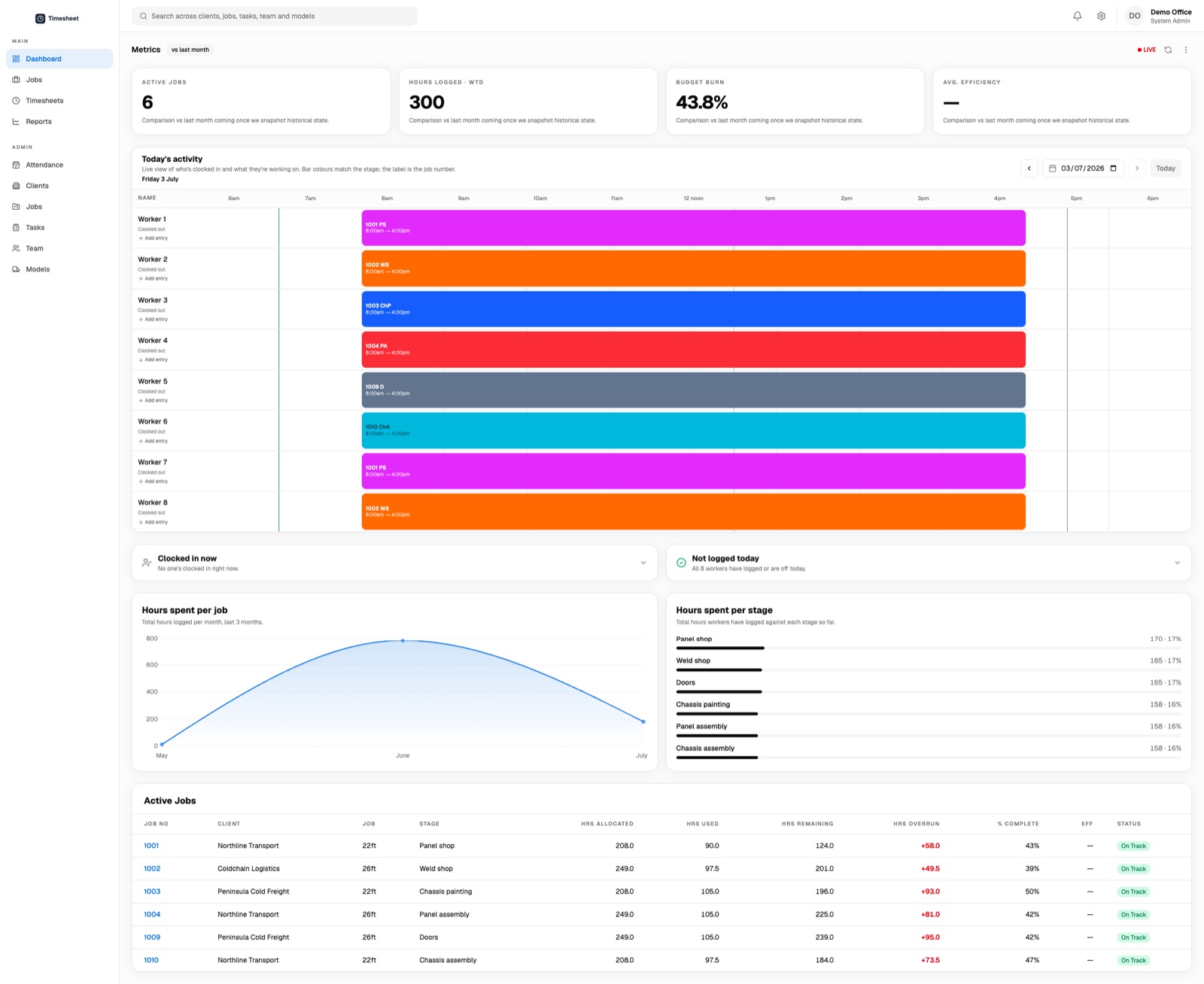
A quoting system, job tracking, a live dashboard on the workshop wall and tablets in the office. One system, four weeks, fixed price. Everyone from the floor to the front desk works off the same numbers.
How a build usually goes.
One scoping call, a price in writing, and working software in your business within weeks. No retainers and nothing rolling on afterwards.
Scope
One call to get specific about the problem and what finished actually looks like. Then a fixed price, in writing.
Build
I build it myself, end to end. The scope is locked, and anything that changes gets agreed before I touch it.
Ship
Working software handed over in four to six weeks, and then I’m out of your way.
Things I’m building myself.
Part of the reason I only take on a handful of client builds a year.
What I’m working on.
What’s shipped, what’s still in progress, and what I’ve pitched for. Updated whenever there’s something worth adding.
Wrapped up a client build for a Geelong manufacturer. Fifty years of paper time cards replaced with tablets on the workshop wall and a live dashboard in the office, in about four weeks. The paper is gone and the office can finally see where every job sits without waiting until end of day. Wrote the whole thing up in the articles section.
Bogey Mates is now live and in public beta testing. After months of work, the golf social network is now live at www.bogeymates.com.au. The app is a social network for golfers to connect with friends, find new courses and play together. The app is free to use and is available on iOS and Android.
Built admin panel for office staff to get an operations overview of the business to make more informed decisions.
Finalised scoring data, course data and polygon mapping for Bogey Mates. Now in beta with testers.
BirdieSmash 1.2.0. Added alignment to the square golf launch monitor connector, part of the kids games software I open sourced.
Plans v0.12. Built a proposals and forms section for the travel agent tool.
Built tool for workers to log time and sync with back of house staff to manage rosters and payroll.
Bogey Mates alpha shipped to four golf friends. Still working through getting lat/long gps data and tees for courses around Australia.
Taking bookings for July through September. After that I'm heads-down on Plans for the rest of the year.
Pitched for work on a golf swing analysis tool using AI and Machine Vision technology.
Started prototyping Savora. Group payments are a lot gnarlier than I remembered, which is roughly why I want to have a go at it.
Notes from the workbench.
Writing about the builds I take on, the products I’m making, and the things I’ve got wrong along the way.
Fifty years of paper time cards, gone in about four weeks
A Geelong manufacturer had tracked its work on paper cards and a spreadsheet that was always a day behind. Here's what it took to replace all of it with tablets on the workshop wall and a live dashboard in the office.
Why I quote a price for the project instead of billing by the hour
I get asked about this often enough that I wanted to write the answer down properly once, including the part that isn't especially flattering to me.
Where to start with internal automation, and where to stop
The question I get most from operations leads is where to start. The honest answer is smaller than you'd think, and sooner than you'd think.
Chris Jack.
Over two decades of building software for large Australian businesses. StackCraft is the client work. The products are the longer bet.
I live in Geelong. I’ve spent twenty-two years building software for Coles, Woolworths, Seek and MYOB, and now I build it for businesses here.
StackCraft is a small practice on purpose, a handful of fixed-price builds a year for businesses that want one person on their quoting system, website, app or internal tool from start to finish. You get me on the tools, not an account manager and a team you never meet.
Away from client work I’m building a few things of my own. Plans is an itinerary tool for travel agents. Bogey Mates organises group golf trips. Savora handles the kitty for group events. And BirdieSmash is a set of open-source golf-simulator games I build with my kid. All of it exists because building things is what I want to be doing.

Twenty-two years of it.
Senior product design roles at Australian businesses. This is employment history rather than a client list.